
How to Tell If Your Longmont Home Has Galvanized Pipes
A practical way to check, without opening a wall, whether your home's supply lines are the original galvanized steel.
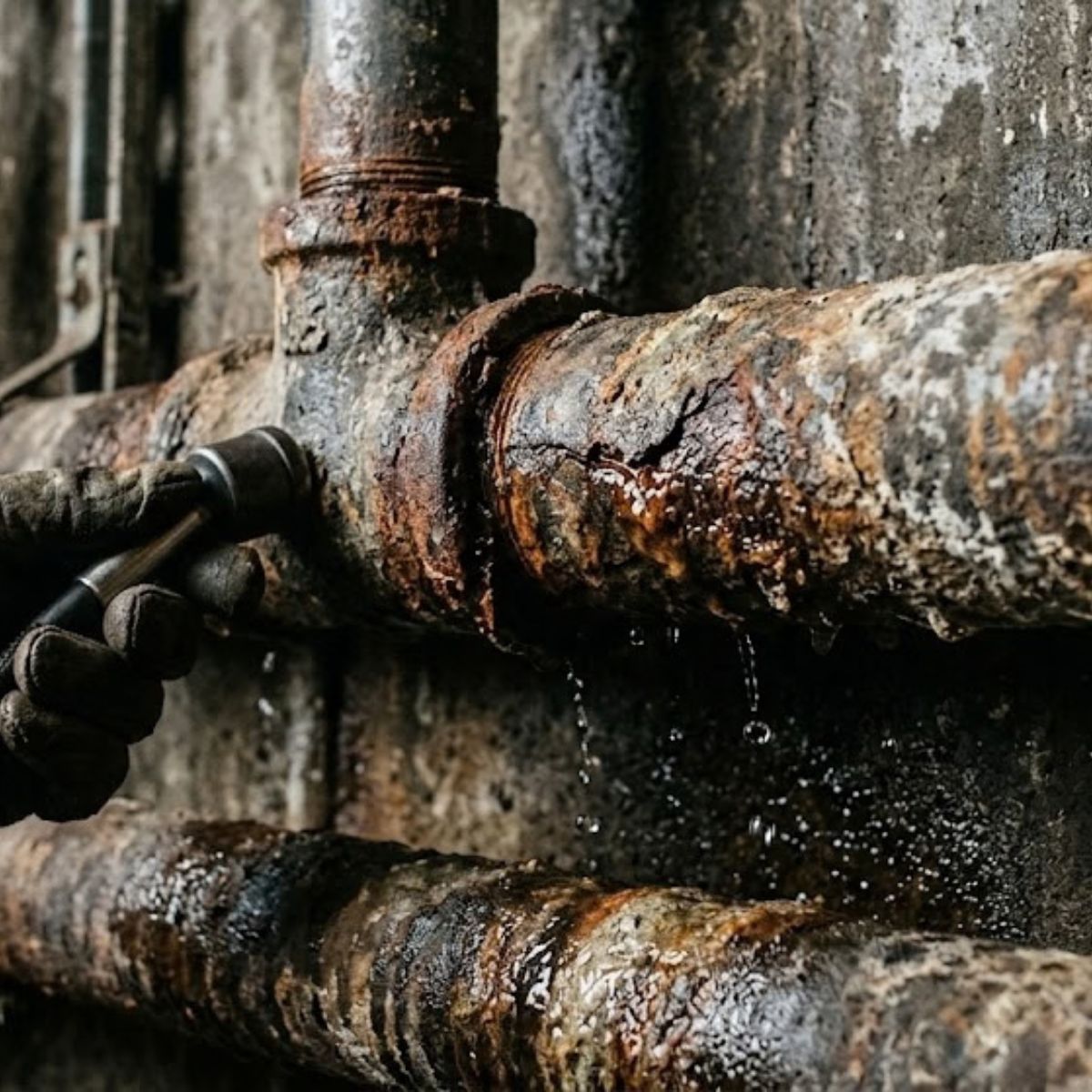
If your Longmont home was built before the 1970s, particularly in one of the older blocks closer to downtown, there's a real chance it's still running on its original galvanized steel supply lines. Galvanized pipe was the standard material for decades before copper and later PEX took over, and a lot of it is still in service today, quietly corroding from the inside in a way that doesn't show up until it fails.
The good news is you don't need to cut into a wall to get a strong first read on what you're dealing with. A few checks, done from outside the wall, narrow it down considerably.
Check the Exposed Pipe First
The fastest check is visual. Look at any exposed supply line, typically in a basement, crawlspace, or utility closet near the water heater. Galvanized pipe is a dull gray color and magnetic, meaning a refrigerator magnet will stick to it. Copper is a reddish-brown color and non-magnetic. PEX is a flexible plastic tubing, usually red, blue, or white, and obviously not metal at all.
If you can find a threaded joint, galvanized pipe typically shows visible corrosion or a rough, pitted texture around the threads even when the pipe itself still looks intact further down its length. That pitting is the visible sign of the same internal corrosion process that eventually causes a leak.
A Simple Water Test
Beyond the visual check, water quality itself is a real clue. Galvanized pipe that's corroding internally will occasionally produce rust-colored or brownish water, especially the first draw of the day after water has sat in the pipes overnight. Run a cold tap first thing in the morning into a clear glass and look at it before using any other water in the house. Consistent discoloration, not a one-time fluke after a nearby water main repair, is a real sign worth investigating.
Why This Actually Matters
Galvanized pipe doesn't fail all at once. It corrodes from the inside along its entire length, gradually narrowing the internal diameter with rust and mineral buildup before eventually developing a pinhole leak at whichever point happens to be weakest first. That's the detail that changes how a leak in galvanized pipe should be handled differently than a leak in copper or PEX.
A single leak in a copper line is usually just that: one isolated failure, fixable with a spot repair. A single leak in a galvanized line is a signal that the rest of the line, not just that one section, is at similar risk, since the corrosion causing the leak has been happening uniformly along the pipe's length, not just at one random spot.
This is also why gradually reduced water pressure over months or years, not a sudden drop, is a real symptom worth paying attention to on an older Longmont home. It usually means internal corrosion is narrowing the pipe's effective diameter throughout the house, which is a broader problem than a single fixture acting up.
What to Do If You Confirm Galvanized Pipe
Confirming galvanized pipe doesn't mean an emergency, and it doesn't mean the whole house needs to be repiped tomorrow. What it does mean is treating any single leak as a signal to have the broader system evaluated rather than assuming a one-off repair solves the underlying issue. A real leak detection visit can confirm not just where the current leak is, but give an honest read on the rest of the line's condition based on what the technician sees once a section is actually opened up.
For a home confirmed to be on original galvanized supply lines with more than one leak showing up over time, that's usually the point where repiping the whole system, rather than continuing to patch individual failures, becomes the more cost-effective long-term answer. It's worth an honest conversation about the real trade-off between continued spot repairs and a full repipe, based on the specific pattern your home is showing.
A Quick Reference
| Sign | What It Suggests |
|---|---|
| Dull gray, magnetic pipe | Likely galvanized steel |
| Reddish-brown, non-magnetic pipe | Likely copper |
| Flexible colored plastic tubing | Likely PEX |
| Rust-colored water, especially first draw | Possible internal corrosion |
| Gradual pressure drop over months | Possible narrowing from internal scale/corrosion |
| Pitted threads at joints | Visible sign of ongoing corrosion |
How Old Is Old Enough to Worry About?
Galvanized supply lines were the standard material through roughly the 1960s in most of the country, with copper gradually taking over through the 1970s and 80s, and PEX becoming common from the 1990s onward. A Longmont home's construction date is a reasonable starting guess, but it's only a guess. Some homes had partial repiping done at some point without full documentation, and some older sections can persist even in a home that's had other plumbing work done over the years.
This is exactly why the physical checks described above matter more than the construction date alone. A home built in 1958 might have been fully repiped in 1995 and have nothing galvanized left, while a home built in 1965 might still be running on its entire original system. The only way to know for certain is to actually look at the pipe.
If You're Buying an Older Longmont Home
Pipe material is worth asking about directly during a home purchase, separate from the sewer line condition, which is a different system entirely and worth its own inspection. A seller may not know the answer with certainty either, especially if they weren't the one who owned the home when any prior plumbing work was done.
If the age and visual signs point toward galvanized supply lines, it's reasonable to factor a future repipe into your overall budget for the home, even if there's no active problem yet. That's a very different financial planning conversation than discovering it as a surprise after a leak shows up in year two of ownership.
Not sure what's running through your walls?
We can confirm pipe material and condition as part of a real diagnostic visit.
Frequently Asked Questions
Is galvanized pipe dangerous to drink from?
Older galvanized pipe can leach lead if it was connected to lead fittings or a lead service line, which was common practice decades ago. If you're concerned about water quality specifically, a filtration system is worth discussing alongside any pipe material questions.
How much does it cost to replace galvanized pipe?
It depends heavily on whether a full repipe or a partial one makes sense for your specific situation, which is worth an honest, on-site conversation rather than a guess.
Can I mix galvanized and copper pipe?
It exists in a lot of older homes as a result of partial past repairs, but directly joining galvanized and copper without a proper dielectric fitting causes accelerated corrosion at that junction specifically.